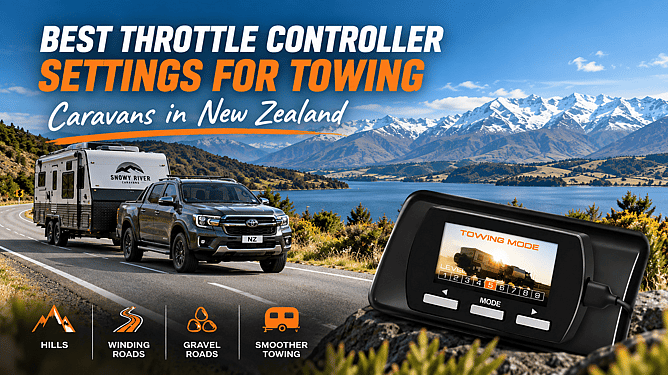
Towing a caravan around New Zealand can put your vehicle to the test.
From climbing the Desert Road and winding through the Central Plateau to tackling the steep roads of the South Island, towing conditions can change quickly. Add a fully loaded caravan or camper trailer behind your 4WD or ute and sluggish throttle response can become much more noticeable.
One of the most common frustrations when towing is pressing the accelerator and feeling a delay before your vehicle responds — particularly when pulling away, climbing hills or preparing to overtake.
An iThrottle Throttle Controller can help by changing the way your vehicle responds to accelerator input, giving you greater control over throttle response to suit the road, load and driving conditions.
So, what are the best throttle controller settings for towing a caravan in New Zealand?
Let’s take a closer look.
Why Does Your Vehicle Feel Sluggish When Towing?
Most modern 4WDs and utes use an electronic, or “drive-by-wire”, accelerator rather than the traditional mechanical throttle cable found in older vehicles.
The accelerator pedal sends an electronic signal to the vehicle, with the factory throttle mapping determining how quickly it responds.
Manufacturers generally tune this response to balance factors such as smoothness, fuel economy and everyday drivability.
But when you add the extra weight of a caravan, boat or heavy trailer, that factory throttle response can sometimes feel frustratingly slow.
You may notice it most when:
Pulling away from intersections
Merging into traffic
Climbing steep hills
Accelerating onto the open road
Overtaking
Towing into a strong headwind
Driving on winding or undulating roads
Popular New Zealand tow vehicles such as the Ford Ranger, Toyota Hilux, Toyota Land Cruiser and Prado, Isuzu D-MAX, Mitsubishi Triton, Nissan Navara and Volkswagen Amarok can all have electronic throttle systems where changing throttle sensitivity may improve the way the vehicle feels to drive.
What Does an iThrottle Controller Actually Do?
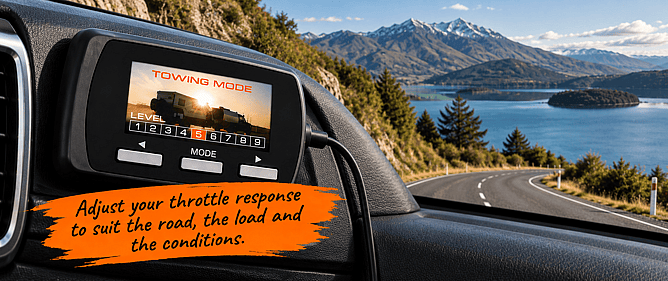
It’s important to understand what a throttle controller does — and what it doesn’t do.
An iThrottle Controller doesn’t increase your engine’s horsepower or torque.
Instead, it changes the relationship between how far you press the accelerator and how quickly the vehicle responds.
Think of it as giving you greater control over the sensitivity of your accelerator pedal.
This can make your vehicle feel more responsive when you need it, or allow for gentler and more controlled throttle input when conditions call for it.
For towing, finding the right balance is particularly important.
You generally don’t want an overly aggressive accelerator response with a heavy caravan behind you. Instead, you’re looking for a setting that reduces that sluggish feeling while still providing smooth, predictable acceleration.
Best iThrottle Settings for Everyday Caravan Towing
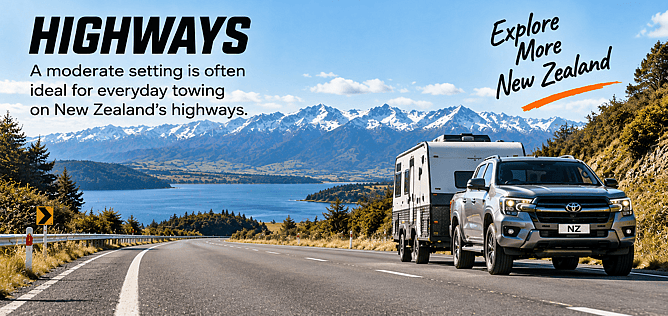
For normal New Zealand highway towing, we recommend starting with a moderate throttle setting rather than immediately selecting the most responsive option available.
The aim is to improve accelerator response without making the vehicle feel too sharp or jerky.
This can be particularly useful when towing along roads such as State Highway 1, where conditions can vary between long open stretches, rolling hills, towns and winding sections.
Start conservatively and gradually adjust the iThrottle until you find the response that suits:
Your particular vehicle
The weight of your caravan
The road conditions
Your driving style
Every vehicle and towing combination is different, so there isn’t one setting that’s perfect for everyone.
Towing Through New Zealand’s Hills
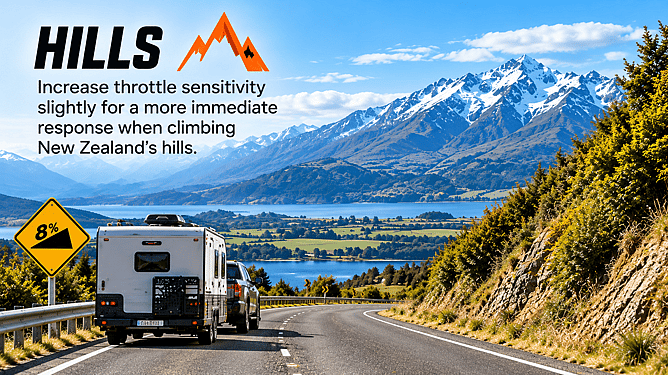
This is where a throttle controller can really change the way your tow vehicle feels.
Anyone who has traveled around New Zealand with a caravan knows that genuinely flat roads don’t always last long.
Whether you’re heading through the Central Plateau, Coromandel, Hawke’s Bay, the Kaimais or tackling South Island mountain roads, hills can quickly highlight throttle lag.
When approaching a longer climb, you may find that increasing throttle sensitivity slightly gives you a more immediate response from the accelerator.
This doesn’t give the engine additional power.
What it does is reduce the amount of pedal movement required to request more throttle, which can make the vehicle feel more responsive under load.
Remember that a throttle controller doesn’t replace appropriate gear selection or good towing technique. Your vehicle still needs to be operated within its manufacturer’s towing limits.
What About Overtaking While Towing?
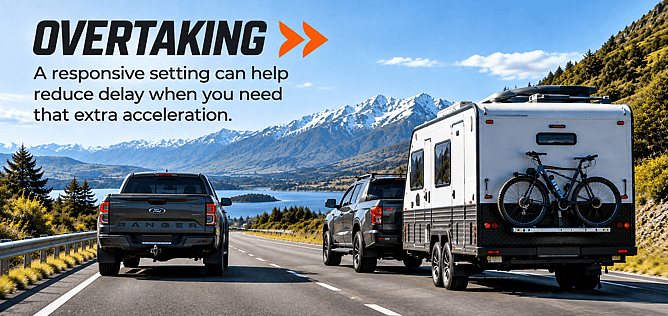
Overtaking with a caravan requires considerably more planning than overtaking without one.
A more responsive throttle setting can reduce the delayed feeling between pressing the accelerator and receiving the throttle response you’ve requested.
This can make acceleration feel more immediate.
However, that doesn’t mean selecting the most aggressive setting possible.With a heavy caravan behind you, smoothness and stability remain extremely important. A moderate setting that provides predictable response is generally preferable to an unnecessarily aggressive throttle setting.
Always allow plenty of space and only overtake when road conditions, visibility and the performance of your complete vehicle-and-caravan combination make it safe to do so.
Winding New Zealand Roads
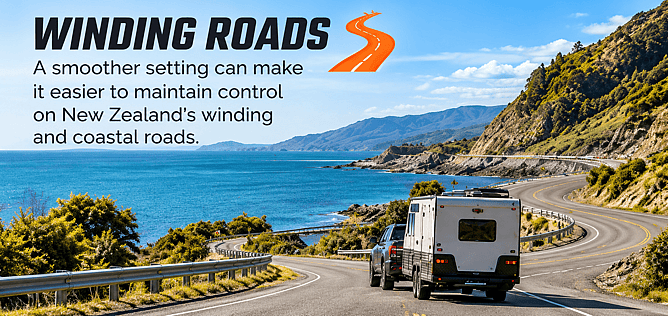
Our roads aren’t all motorways and long straight highways.
Some of New Zealand’s best caravan destinations involve narrow, winding and hilly roads.
Think Coromandel, Northland, East Cape, the West Coast, Marlborough Sounds and many of our lakeside and coastal camping destinations.
In these conditions, a slightly softer throttle response may actually be preferable.
Why?
Because smooth accelerator input makes it easier to maintain consistent progress through corners and reduces unnecessary surging from the tow vehicle.
The most aggressive setting isn’t necessarily the best setting.
Control is the goal.
Gravel Roads and Campsite Access
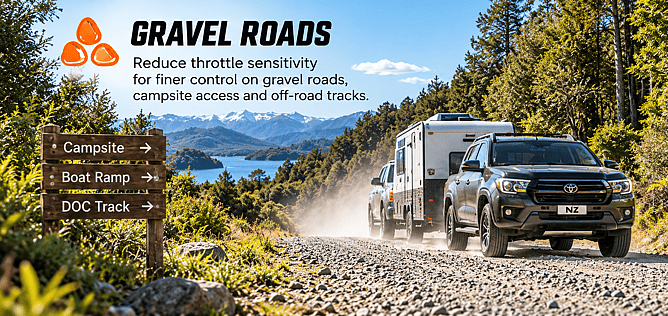
Many fantastic New Zealand camping locations involve leaving the sealed road behind.
Gravel roads, DOC campsite access roads, farm tracks and rough campground entrances all require a different approach from highway driving.
Reducing throttle sensitivity can provide finer control at lower speeds and make it easier to apply power smoothly.
This can be particularly useful where you’re dealing with:
Loose gravel
Mud
Steep campsite access
Uneven tracks
Wet grass
Boat ramps
Low-speed manoeuvring
Smooth throttle application can help reduce unnecessary wheel spin and give you better control over where the vehicle is going.
Can I Use Eco Mode While Towing?
A softer or Eco-style setting can be useful in certain towing situations, particularly on relatively flat roads where you’re maintaining a consistent cruising speed.
However, if you’re towing a heavier caravan through hilly country, you may find a very soft throttle setting makes the vehicle feel unnecessarily sluggish.
Again, there isn’t a single perfect setting.
One of the advantages of having an adjustable throttle controller is being able to change the response to suit where you’re driving.
Don’t Automatically Turn It Up to Maximum
It’s tempting.
You install your new throttle controller, turn it straight up and see what it can do.
When you’re towing, that’s generally not the best approach.
Very responsive settings can make small accelerator movements produce much larger throttle changes. With a heavy caravan behind you, that can result in acceleration that feels unnecessarily abrupt.
Instead:
Start at a moderate setting – drive the vehicle – make small adjustments – find the setting that feels comfortable.
You want your vehicle to feel responsive, not aggressive.
Match Your Setting to New Zealand Conditions
One of the biggest advantages of an iThrottle Controller is that you’re not locked into one throttle response.
Your ideal setting cruising along a relatively flat highway may be completely different from the setting you prefer while negotiating a steep gravel road into a remote campsite.
For example:
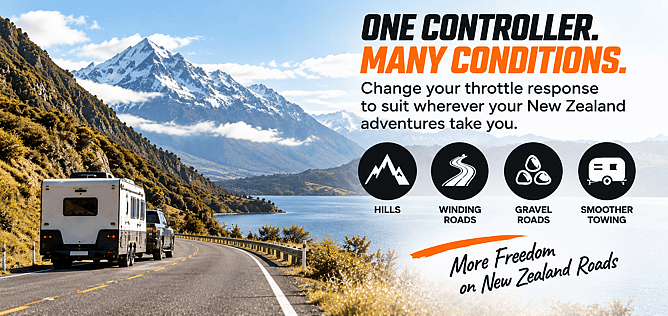
Open-road caravan towing:
Moderate throttle response for smooth, predictable acceleration.
Steep hills:
Increase sensitivity slightly if you want a more immediate accelerator response.
Winding roads:
Consider a smoother setting that makes progressive acceleration easier.
Gravel and loose surfaces:
Reduce sensitivity to help with precise throttle control.
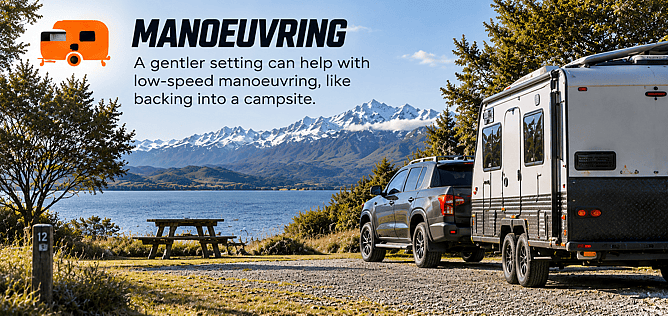
Low-speed manoeuvring:
A gentler setting can make backing your caravan into a campsite easier and more controlled.
The key is to adjust the controller to the conditions rather than assuming one setting will be best everywhere.
Does an iThrottle Controller Give You More Towing Power?
No — and this is an important distinction.
A throttle controller does not increase engine horsepower or torque.
If your vehicle produces 500 Nm of torque before installing an iThrottle, it isn’t suddenly producing more torque afterwards.
What changes is how quickly the throttle responds to your accelerator input.
Reducing throttle lag can make a vehicle feel considerably more responsive, particularly when it’s working under the additional load of a caravan.
Is an iThrottle Worth Having for Caravan Towing?
For drivers frustrated by sluggish accelerator response, an iThrottle Controller can be a useful addition to a tow vehicle.
New Zealand presents caravan owners with an enormous variety of driving conditions — often during the same journey.
You might leave home on an urban road, join the motorway, cross rolling farmland, climb a mountain pass and finish your day negotiating a gravel access road into a campsite.Being able to adjust your vehicle’s throttle response to suit those different conditions gives you another level of control over how your vehicle feels to drive.
And when you’re towing, smooth and predictable control matters.
So, what’s the best iThrottle setting for towing a caravan in New Zealand?
For most drivers, the best place to start is with a moderate setting that improves throttle response without making acceleration overly sensitive.
From there, make small adjustments depending on your vehicle, caravan and driving conditions.
You may prefer a little more response when climbing hills and a softer setting when traveling over gravel or manoeuvring around a campground.
There isn’t one magic number that suits every tow vehicle.
The best setting is the one that gives you smooth, predictable and comfortable throttle control for your particular towing setup.
Improve Your Towing Experience with iThrottle NZ
Whether you’re towing the caravan away for a long weekend, touring the South Island or setting off on an extended trip around New Zealand, iThrottle gives you the ability to tailor your vehicle’s throttle response to suit the journey.
The iThrottle Throttle Controller offers adjustable throttle response along with additional features designed for modern 4WDs and utes.
Check whether iThrottle is compatible with your vehicle and discover how much better your tow vehicle could feel on your next trip.
Always drive to the conditions, follow your vehicle and caravan manufacturers’ towing recommendations, and remain within all applicable weight and towing limits.